

🤖 AI Expert Verdict
Integrating AI and machine learning (ML) into a data warehouse enhances speed, efficiency, and data quality by automating tedious tasks such as data cleansing, validation, and integration. AI handles explicit automation and complex data processing, while ML specializes in identifying hidden patterns, optimizing schema architecture, and providing superior predictive analytics based on historical data trends. This combination democratizes data access and ensures the data warehouse operates as a scalable, high-performance single source of truth.
- Automates repetitive data management tasks (ETL, validation)
- Significantly improves query speed and data processing efficiency
- Enables proactive predictive analytics and anomaly detection
- Optimizes data storage and warehouse schema architecture
- Democratizes access to BI insights for non-technical users
How AI and Machine Learning Transform Data Warehouse Efficiency and Insights
The modern enterprise runs on data, and the data warehouse (DW) is the central engine powering business intelligence (BI) and analytics. However, as data volumes explode and complexity increases, traditional data warehouse management can become cumbersome. The key to unlocking speed, efficiency, and higher-quality insights lies in the strategic integration of Artificial Intelligence (AI) and Machine Learning (ML).
The Data Warehouse: The Single Source of Truth
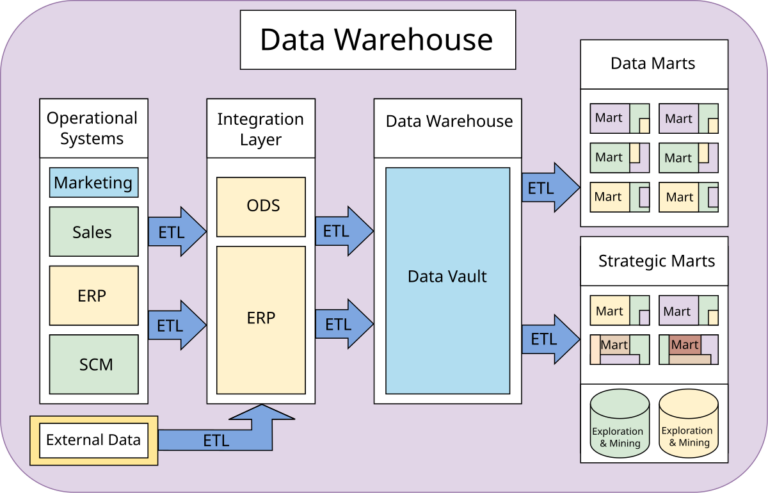
A data warehouse is fundamentally a central repository designed to store data pulled from disparate operational sources, such as relational databases and transactional systems. Unlike raw data storage, a DW organizes this information based on predefined schemas, making the data structured and ready for rapid analysis, reporting, visualizations, and ad hoc querying by BI applications.
Functioning as an organization’s single source of truth, the data warehouse gathers input from every department, creating a comprehensive and architecturally sound database. This centralized structure not only simplifies access but also provides the massive, high-quality datasets that AI and ML applications require to function optimally.
Understanding the Difference: AI vs. Machine Learning
While often used interchangeably, AI and ML have distinct roles:
- Artificial Intelligence (AI): AI enables machines to simulate human logic to solve problems and make decisions based on data. It excels at automating complex or repetitive tasks, optimizing processes, and overseeing detail-oriented functions that traditionally require explicit programming instructions.
- Machine Learning (ML): ML is a subset of AI focused on learning. ML algorithms analyze vast datasets, learn from the patterns discovered, and incrementally improve their accuracy over time without being explicitly programmed for every decision. This learning capability makes ML ideal for predictive analytics, forecasting, and data classification.
5 Ways AI and ML Supercharge Data Warehouse Operations
Integrating AI and ML into a data warehouse enhances core functions, improving both processing power and operational oversight.
1. Automation of Data Management Tasks
AI is perfect for automating the tedious, repetitive, and intensive data tasks that consume valuable human resources:
- Data Integration: Ensuring smooth, continuous connections between data sources and the warehouse pipeline.
- Performance Monitoring: Automatically checking for broken connections and ensuring all critical processes are active and functioning as expected.
- Data Cleansing and Validation: Verifying data elements are accurate, complete, and consistent.
By automating these crucial processes, IT administrators and data teams are freed to concentrate on higher-value strategic responsibilities.
2. Enhanced Data Processing and Query Optimization
Both AI and ML excel at parsing large volumes of data quickly. AI can be programmed to handle simple, common queries swiftly, while ML algorithms can be trained to manage highly complex queries. This combined approach significantly improves the speed of data processing, allowing the warehouse to handle larger and more intricate datasets.
Furthermore, ML can analyze historical query performance to identify patterns and bottlenecks—for instance, noting that a particular data task repeatedly slows down an entire process. Uncovering these inefficiencies leads to targeted optimizations that dramatically boost query performance.
3. Intelligent Schema and Architecture Management
Data schema in an enterprise environment can become incredibly complex. AI can manage schema issues proactively by flagging or mitigating errors that could cause massive downstream problems. ML takes this further by analyzing schema usage patterns to determine and recommend the most efficient strategies and architectures, resulting in a leaner, more organized, and faster data warehouse.
4. Superior Predictive Analytics and Anomaly Detection
ML’s powerful ability to analyze patterns enables it to identify trends in stored data that human analysts might overlook. Using historical data trends, ML can forecast outcomes, giving the organization a competitive edge by predicting customer demand, market shifts, or potential downtime issues. This proactive approach helps the organization stay one step ahead.
5. Democratization of Business Intelligence
AI and ML not only improve backend efficiency but also broaden accessibility. They can improve data quality and query accuracy, making BI applications easier to use for non-technical users. For example, a user lacking deep data literacy skills can simply input a natural language command and receive insights presented in easy-to-understand formats, such as simplified visualizations. This fosters better-aligned decision-making across the entire enterprise.
The Outcome: A Future-Proof Data Strategy
A data warehouse augmented with AI and ML is not just faster and more efficient; it is future-proof. It scales more quickly and easily alongside organizational growth and evolving technological demands. By optimizing data storage (e.g., automatically identifying and deleting redundant data) and automating ETL (Extraction, Transformation, Loading) processes, AI and ML provide cost-effective operations, freeing up data teams to focus on core business responsibilities that drive the bottom line.
Reference: Inspired by content from https://www.techtarget.com/searchbusinessanalytics/tip/Reasons-to-use-AI-and-machine-learning-in-a-data-warehouse.